The most expensive G.I. Joe toys people ever sold can cost from a few hundred dollars to more than $200,000. The rarest pieces get really big money at auctions. Hasbro started this famous toy line in 1964. Now, many years later, some figures and big playsets became real things to invest your money in. Maybe you like them for a long time, or maybe you just found a dusty old box in your roof room. Either way, it is good for your time to know which pieces have real value.
The $200,000 Prototype That Began Everything
The number one most expensive G.I. Joe ever sold is the 1964 Prototype 12-inch Action Figure. It sold at an auction in 2003 for $200,001.10. Don Levine, who was the Hasbro Creative Director, painted this figure by his own hands. He made it to show the first idea for the whole toy line. It is a unique thing, not a toy made in a factory, so it stays in its own special category. No other G.I. Joe is like this for history or for the dollar price.
The Venezuela Variant That Collectors Look For All the Time
If we look at normal toys from stores, the Rubiplas “Cobra White Mortal” from Venezuela is probably the most valuable G.I. Joe toy. Rubiplas was a local company there, and they made this carded Cobra figure in the late 1980s for their market. They made very few, and people rarely sent them to other countries. But you can still sell a loose one in bad condition for $5,000 or more. And if it is Mint on Card in really great condition? It came close to $50,000. Because of that, it is the dream toy for collectors.
Why International Variations Cost So Much Money
In the 1980s, countries outside America got G.I. Joe toys from local companies with a license. Those companies made much smaller numbers of toys than Hasbro made in the US. Argentina, Brazil, Venezuela, and some parts of Europe had their own special versions. They made them for smaller markets, so fewer toys survived. And even fewer stayed in sealed boxes or perfect condition. Collectors look specifically for toys from Estrela in Brazil and Rubiplas in Venezuela. The regional scarcity makes the price go much higher than the American toys.
How Grading Helps to Change the Price
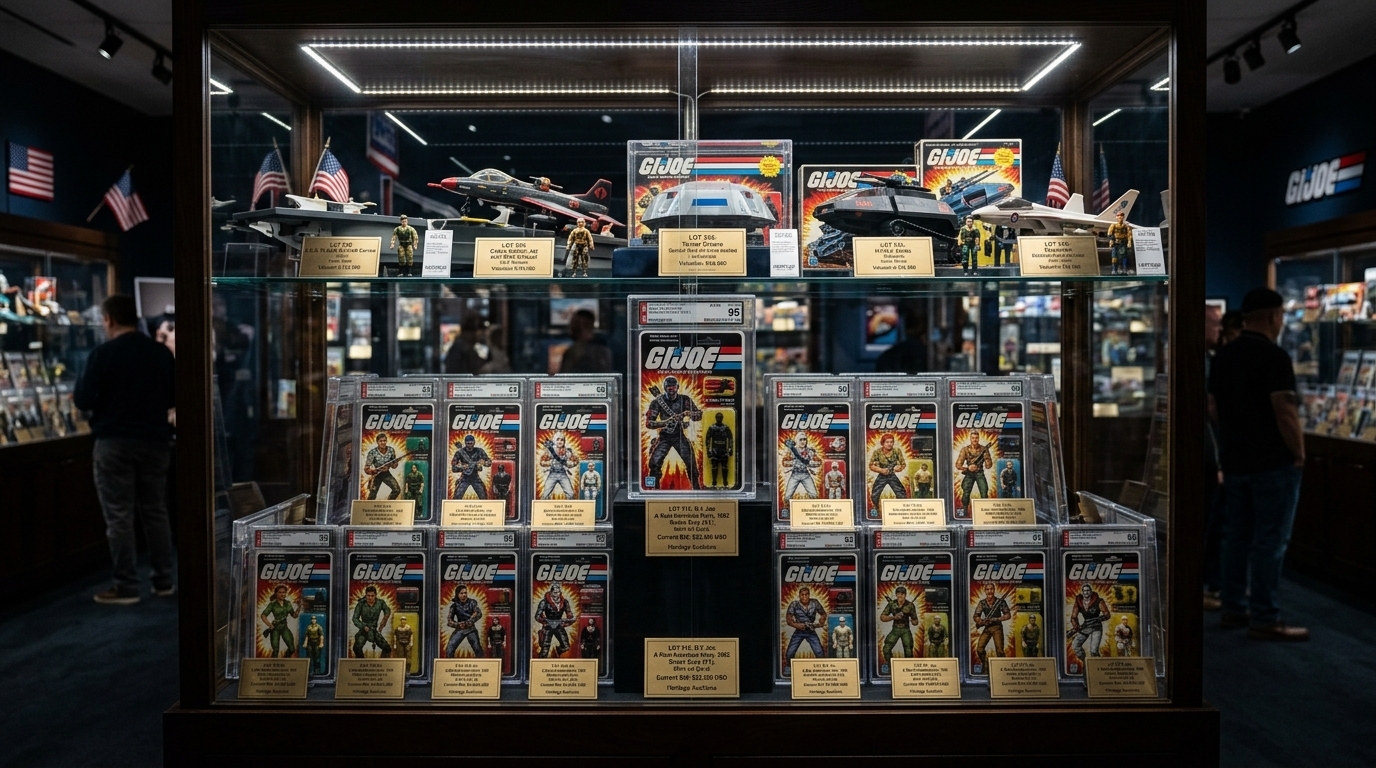
Condition means everything in the G.I. Joe market. The Action Figure Authority (AFA) and Collector Archive Services (CAS) are two places that give professional grading. They look at the figure, give it a number score, and put it inside a plastic case that you cannot open easily. An AFA 85 graded figure can cost three to five times more than the same figure without a grade. This happens simply because the score makes buyers feel safe about the quality and that it is real. Also, Mint on Card (MOC) figures that nobody ever opened always make way more money than loose figures from the same line.
Old 1964 to 1969 Boxed Sets
The first 12-inch figures from the very first years have big value. But you need to find them with their original boxes and tools. A 1964 Action Soldier in the original box with all weapons and clothes can sell for $1,000 to $3,000 if the condition is good. Nurse figures from these years are very rare because they made fewer of them, and it is hard to find them with all pieces. And any extra clothing pack or accessory set from this time that is still sealed in the original paper box adds a lot of money to the value.
Big Playsets From the Real American Hero Years
The 1980s Real American Hero line had some huge playsets, and now they are some of the most expensive G.I. Joe toys from that time. The U.S.S. Flagg aircraft carrier came out in 1985, and it is the biggest G.I. Joe playset ever. It is longer than seven feet when you build it. To find a complete Flagg in great condition with all the small parts is super hard. So it gets prices from $3,000 to $5,000. Hasbro also made the Defiant Space Launch Complex in 1987. That is another popular set, and it sells regularly for $1,500 or more if it is complete.
Mail-Away Toys and Their Surprising Value
All through the 1980s, Hasbro had special mail-away figures. You could not buy them in stores, you had to send points from other G.I. Joe boxes to get them. Toys like the first Mail-Away Snake Eyes from 1982 and Salvo from later years were like this. Parents almost never kept the brown boxes and papers, so finding these figures inside their real mailing boxes with the paperwork is truly rare. Complete mail-away sets in original condition often get $500 to more than $2,000 at auctions.
How People Really Measure Rarity
Collectors use many things to see if a toy is rare, not just the production numbers. Some figures were “short-packed,” which means they put fewer of that character inside the big store box. Because of that, they are harder to find than figures that came in big numbers. Also, exclusive toys from foreign markets add a geographic scarcity. Sometimes they stopped making a figure early because of safety problems or because they changed the character, and those toys become popular immediately. To see the real market price for a piece, you should check auction results on eBay and Heritage Auctions, and look at grading databases too.