Most superhero comics work in self-contained arcs. Six issues, done, next threat. Hickman doesn’t do that. He’s playing a much longer game, the kind where something mentioned in issue 570 quietly destroys you emotionally in issue 604. You don’t even realize the setup is happening until it lands.
And he actually treats the Fantastic Four like a family. Reed is brilliant but obsessed. Sue is the one holding everything together while her husband tries to solve the universe. Johnny and Ben feel like real people rather than plot furniture. The cosmic stuff is there, yes, multiverses, secret underground civilizations, ancient races, but it’s always anchored in these relationships. That’s why it works.
The Reading Order
Start here and don’t deviate:
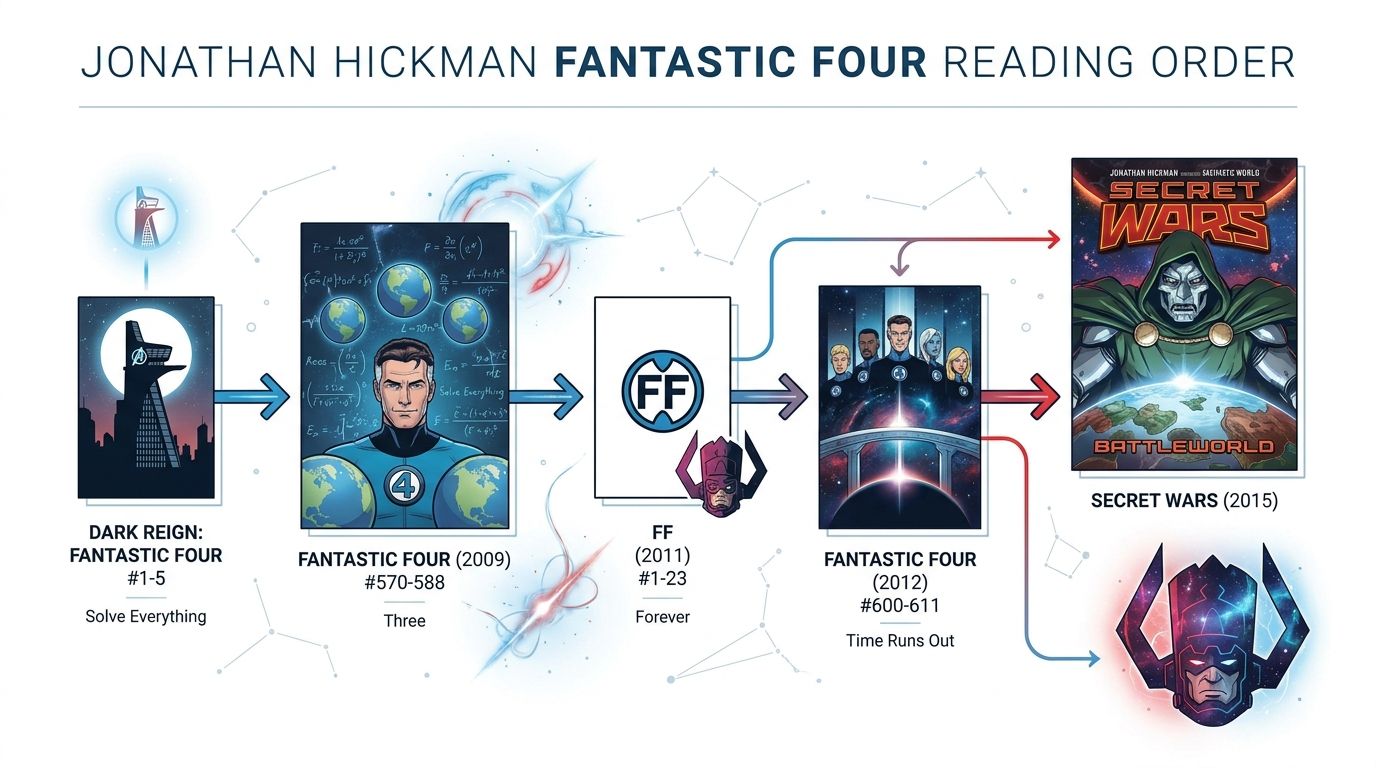
Fantastic Four #570–574 (Vol. 1) This is your entry point. Reed meets the Council of Reeds: alternate versions of himself who all abandoned their families to fix everything. It’s immediately compelling and immediately uncomfortable, which is exactly the right note to open on.
Fantastic Four #575–578 (Vol. 2) The world gets bigger. Nu-World, the Inhumans, underground races. Hickman is laying track here.
Fantastic Four #579–588 (Vol. 3) This is where you start feeling it. The Future Foundation starts taking shape and the emotional stakes quietly begin climbing.
Fantastic Four #589–588, including the “Three” arc (Vol. 4) Don’t look up spoilers. Seriously. Something happens in this arc that genuinely shocked readers at the time, and it hits hardest if you don’t see it coming.
Then it splits. Starting around issue 587, a companion series called FF (Future Foundation) launches and runs alongside the main book. From here you read them together, woven in this order:
FF #1 → FF #2 → FF #3 → FF #4 → FF #5 → FF #6 → FF #7 → FF #8 → FF #9 → FF #10 → FF #11 → FF #12 → FF #13 → FF #14 → FF #15 → FF #16
Interspersed with: Fantastic Four #589, 600, 601, 602, 603, 604, 605, 605.1, 606, 607, 608, 609, 610, 611
Then wrap up with FF #23 and Fantastic Four #611.
Don’t Skip FF
Some people try to read just the main Fantastic Four book and treat FF as optional. They’re wrong. FF is where the interior life of the Future Foundation actually lives, the kids, Nathaniel Richards, Doom operating in morally complicated ways. If you skip it, you show up to the ending not understanding half the relationships that are supposed to matter to you. The finale needs both series to hit properly.
What Makes It Stick
The question running underneath everything is: what would you sacrifice to save the world? Reed Richards is brilliant enough to potentially answer that question, and the run keeps asking whether being that brilliant is actually a good thing. The Council of Reeds storyline makes this explicit, but it echoes through everything. Every major character gets a version of that question put to them.
How Long You’re Looking At
The full run spans Fantastic Four #570 through FF #23 and Fantastic Four #611, published 2009 to 2012, roughly 60 to 70 issues total. Read a few issues a night and you’re done in two or three weeks. It doesn’t drag. Every arc introduces something that connects back and forward simultaneously.
Do You Need Background Knowledge?
No. Genuinely, no. Knowing vaguely who Reed, Sue, Johnny, and Ben are is enough. Hickman doesn’t assume you’ve read 40 years of continuity, he builds his world clearly and lets you find your footing. If you’ve been hesitant because you think you need backstory, you don’t. Start at #570.
Conclusion
Fantastic Four #570, straight through the early volumes, then weave both series together from #587 onward. That’s it. Follow that sequence and you’ll understand why people still talk about this run years later, not as “good for a superhero comic,” but just good. Full stop.